I treat an SCJP exam attempt as a scheduling and risk-control problem before I treat it as a reading plan. A developer who writes Java every week can still lose marks on initialization order, access modifiers, autoboxing, and overload resolution because IDEs and modern frameworks quietly absorb many of those details.
The roadmap below assumes the candidate already works with Java regularly and can set aside a 6- to 10-week preparation window. The point is not to read everything. The point is to expose the parts of Java that the exam asks directly and production work often hides.
The Cost of an Unplanned SCJP Attempt
The expensive part of an unplanned SCJP attempt is not only the exam fee. It is the delay that follows a missed certification date: job applications stay parked, salary conversations lose a supporting credential, and the candidate has to rebuild confidence while paying for another attempt.
I see the same pattern when a developer relies on general Java experience. They can build services with Spring Framework, read production logs, and review pull requests, yet still hesitate when a question compresses declaration rules, flow control, and exception handling into one dense block. The exam does not ask whether a framework handled the edge case. It asks whether the candidate can reason through the rule without an IDE.
Plan the Attempt Before You Plan the Reading
A credible roadmap starts with a calendar. If the developer already writes Java regularly, plan one certification attempt around a 6- to 10-week preparation window. That window is long enough to separate baseline testing, topic study, timed mock exams, and final review. It is also short enough to keep the work tied to a specific exam date rather than an open-ended intention.
Budget for at least one full-length timed rehearsal before paying for the real attempt. A short quiz is useful for recall, but it is not a substitute for a 180-minute sitting with no documentation, no IDE autocomplete, and no pause-and-resume breaks.
Warning: A high score on short quizzes can fail to transfer to the real attempt when the candidate has never practiced three continuous hours of dense multiple-choice reasoning.
When a mock section fails, I do not label it as one broad Java weakness. I split it into remediation queues: declarations, flow control, exceptions, generics, collections, threading, and I/O. That separation matters because each queue needs a different kind of practice.
Assess Your Current Java Proficiency
My hypothesis for baseline work is simple: equal study time is usually wasted study time. The diagnostic comes before topic study so familiar material does not consume the same hours as unfamiliar material.
Run a Short Diagnostic, Then Tag the Misses
Use a diagnostic block of 60 to 90 minutes. Do not turn the first baseline into an all-day test. Fatigue can hide the topic gaps you are trying to measure, especially when similar-looking questions start blending together.
The diagnostic should sample language fundamentals, APIs, and rule-heavy behavior. I tag each missed item against the certification provider's published objectives within the same day, while the reasoning mistake is still clear. For Java SE 8 preparation, use the official Java SE 8 Programmer exam topics as the mapping surface.
Create separate weak-area labels for collections, concurrency, I/O, exceptions, generics, inheritance, access control, and object lifecycle behavior. The labels should be narrow enough that they lead to a drill. “Collections” is still broad, but it is better than “Java.” “Iterator removal and ordering contracts” is better again once you have enough evidence.
For legacy SCJP paths, objective wording matters more than the badge nickname; candidates should verify that their study materials match the exact exam version they intend to sit.
Convert the Baseline into a Work Queue
The useful output of the diagnostic is not a score. It is a queue of mistakes with names.
- Missed access modifier questions become access-control drills.
- Wrong constructor output becomes initialization-order tracing.
- Confused wildcard answers become generics assignment exercises.
- Slow I/O questions become API contract review.
- Thread-state errors become synchronization and lifecycle rehearsal.
This is where framework-heavy Java developers often need more discipline than beginners expect. Candidates coming from application work usually need more time on core language edge cases than on application design patterns.
Sequence Topics for Maximum Retention
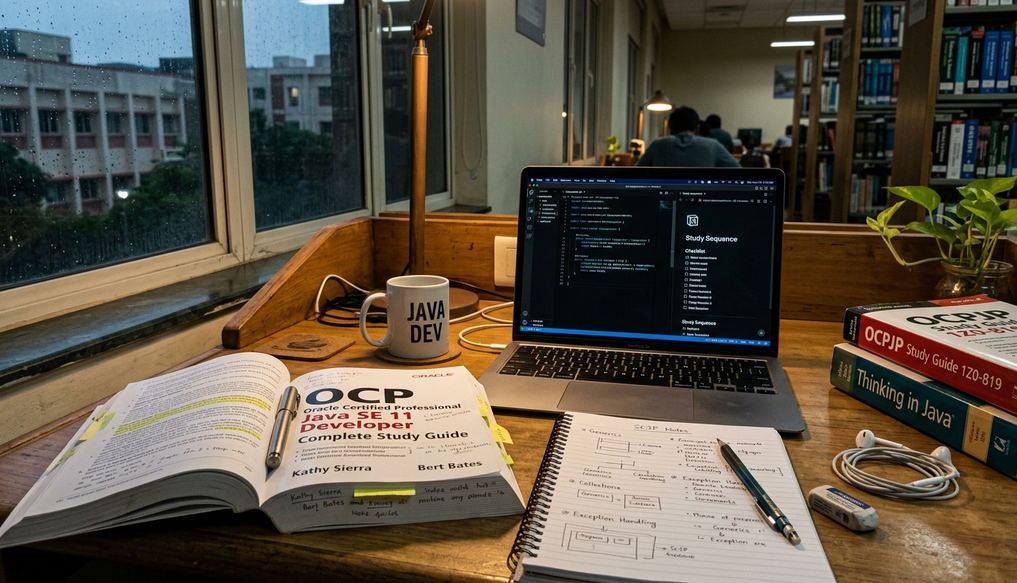
Prior Java study often follows the order of a book, a course, or whatever problem appeared at work that week. That order is convenient, but it is not always aligned with exam dependency. I prefer a sequence built from the language mechanics upward: declarations, initialization, operators, control flow, inheritance, polymorphism, exceptions, generics, collections, threading, and I/O.
Build from Syntax to APIs
Reserve the first 7 to 10 study days for syntax, declarations, scope, initialization order, operators, and control flow. These topics look basic until the exam combines them. A single question can ask for output while hiding a static initializer, a local variable shadowing issue, and a short-circuit condition in the same snippet.
Move into inheritance, polymorphism, interfaces, casting, and exception handling during days 11 to 21. This is where I slow down the reading and increase handwritten or typed trace work. Method selection, overridden behavior, checked exceptions, and reference-type casting are easier to recognize after the candidate has traced several small programs line by line.
Place generics, collections, threading, and I/O after the core language pass, typically during days 22 to 42 in a 6-week plan. This order prevents an API question from becoming two questions at once: one about the library and one about the language rule underneath it.
Pair Every Reading Block with Code
Interleave theory reading with daily coding exercises. The drills should be small, usually 25 to 45 minutes, and they should isolate behavior rather than build applications. I use exercises for constructor chaining, static initialization, overloaded method resolution, iterator removal, and exception propagation.
Pro Tip: If a rule is easy to explain but hard to predict in code, drill it with three tiny programs: one that compiles and runs, one that fails compilation, and one that changes output after a single modifier or type change.
Spaced repetition belongs in this phase, but not as flashcard theater. Schedule repeated passes for syntax, exception handling, access rules, and common API contracts. The spacing works best when the candidate must predict behavior before seeing the explanation.
Incorporate Timed Mock Exams Weekly
The practice data I trust most comes from full simulations introduced after enough topic coverage exists for the result to mean something. From week four onward, the plan should alternate full mock exams with source-level review.
Use Exam Conditions, Not Study Conditions
Begin weekly full-length mock exams between days 22 and 28 of the plan. Run each full simulation under 180-minute conditions with no documentation, no IDE autocomplete, and no pause-and-resume breaks. That environment exposes two separate problems: knowledge gaps and endurance gaps.
Review incorrect and guessed answers within 24 hours. I separate errors into four buckets: did not know rule, misread question, forgot API contract, and time pressure. The bucket matters because the fix changes. A misread question needs annotation discipline. A forgotten API contract needs targeted recall. A time-pressure error may need pacing work, not another chapter of reading.
- Did not know rule: return to the relevant objective and write a minimal code example.
- Misread question: mark the exact word that changed the answer, such as “not,” “compile,” or “runtime.”
- Forgot API contract: review the source documentation and then test the behavior in a small snippet.
- Time pressure: record where the clock was lost and whether the issue was reading speed, code tracing, or second-guessing.
Decide When the Real Exam Belongs on the Calendar
Do not book the real exam after one encouraging mock. Book it only after at least two consecutive full mocks show stable performance with no recurring collapse in the same objective area. The phrase “same objective area” is the important part. A candidate can survive a few scattered misses; repeated collapse in generics, threading, or exceptions points to a study queue that is not finished.
The open question after each mock is specific: what error type still repeats under timed conditions? If the same category keeps appearing, the next week’s plan writes itself.
SCJP Readiness Gate Before Booking
Key Takeaway: Before paying for the real attempt, the candidate should be able to check every item below without negotiation.
- I have mapped every weak diagnostic area to the official exam objectives.
- I have completed daily coding drills for language rules, not just read explanations.
- I have taken at least two full 180-minute mock exams with no pause-and-resume breaks.
- I have reviewed every incorrect and guessed answer within 24 hours.
- I have no recurring collapse in the same objective area across consecutive full mocks.
Execute a 14-Day Final Review Cycle
The final 14 days are not for broad new learning. They are for converting known weaknesses into rehearsed responses. I choose the review order from the candidate’s own error log, with the most damaging objective areas first.
Days 1 to 5: Target the Top Three Weak Objectives
Complete targeted code labs for the top three weak objectives from the mock-exam log. If the log says exceptions, generics, and collections, the labs should not wander into networking, design patterns, or Spring Framework. Keep the work close to the exam surface.
For exceptions, write snippets that force checked exception declaration, multi-catch reasoning, overriding constraints, and finally-block flow. For generics, rehearse wildcard assignment, raw-type warnings as exam clues, and method invocation with bounded types. For collections, compare ordering, equality contracts, iterator behavior, and removal rules.
Days 6 to 9: Rehearse High-Friction Patterns
Use these days for question patterns that repeatedly slow candidates down: thread states, synchronization rules, wildcard generics, collection ordering, equality contracts, and exception flow. The goal is recognition under pressure. I ask the candidate to predict compilation first, runtime behavior second, and output last.
This order prevents a common mistake: calculating output for code that never compiles.
Days 10 to 12: Take the Final 180-Minute Mock
Complete one final 180-minute mock. Review only the missed, guessed, or slow questions. At this point, rereading broad chapters can feel productive, but it often dilutes attention. The final mock review should sharpen the exact decision points that still cost marks.
Days 13 to 14: Prepare the Exam-Day System
Stop heavy new material. Confirm identification requirements, test-center or remote-proctor setup, arrival timing, permitted items, and account login access. Exam logistics should be boring by the time the candidate sits down.
Here is a worked final-cycle example you can copy. Suppose the mock-exam log shows recurring misses in generics, initialization order, and thread synchronization. On days 1 and 2, write five generics snippets each day: one unbounded wildcard assignment, one upper-bounded wildcard read, one lower-bounded wildcard write, one generic method call, and one raw-type trap. On days 3 and 4, trace ten initialization examples by hand: static field, static block, instance field, instance block, constructor, subclass constructor, and overridden method call from construction. On day 5, write four synchronization snippets that contrast synchronized instance methods, synchronized static methods, shared monitors, and separate object locks. On days 6 to 9, answer only questions from those three queues, marking each miss as rule, misread, API contract, or time pressure. On day 10, sit one 180-minute mock with no breaks. On day 11, review the missed and guessed answers. On day 12, rerun only the failed code labs. On day 13, confirm ID, login, route or proctor setup, and permitted items. On day 14, do a 30-minute warm-up with three tiny snippets: one generics assignment, one initialization trace, and one synchronization lock question.